Stop! Don't Build an ADU Until You Read This 2026 California Legal Guide
How to build a legal ADU in California without fines, delays, or financial disaster
Get Free ADU Legal Assessment →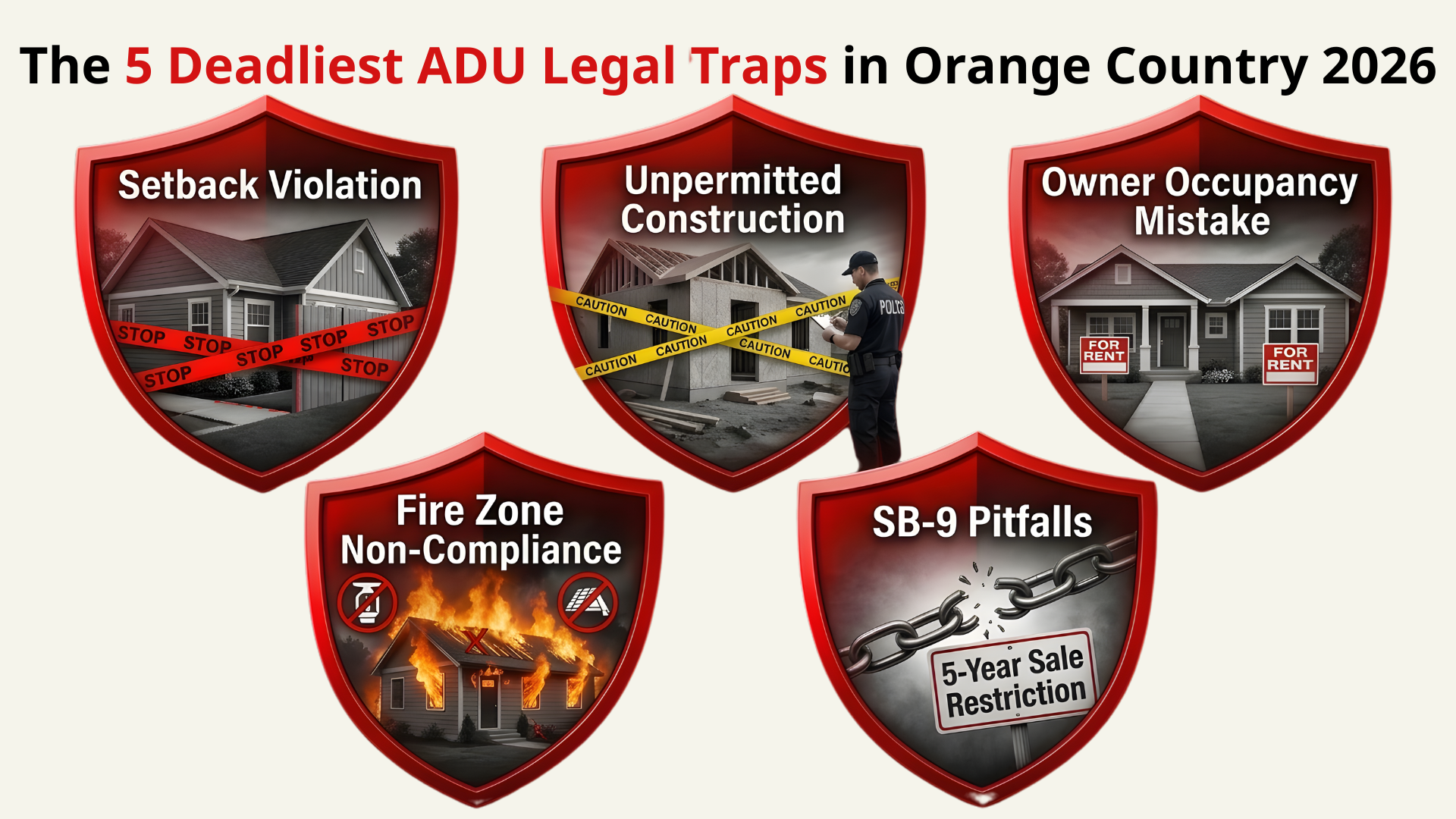
The $35,000 Mistake That Almost Cost a Garden Grove Family Their Home
Let me tell you about a call I got last year. It was 7:30 PM on a Tuesday, and the woman on the line was crying.
Her name is Maria. She and her husband had built a beautiful ADU in their Garden Grove backyard - converted their detached garage, added a kitchen, put in nice finishes. They'd been renting it to a young couple for $2,200 a month for two years. It was their retirement plan.
Then code enforcement showed up.
Someone had filed a complaint. Maybe a neighbor. Maybe someone who saw the listing online. It didn't matter. The city inspected and found: no permits, no final approval, no certificate of occupancy.
The city inspected and found:
- No permits
- No final approval
- No certificate of occupancy
The fines started at $500 per day. They racked up $8,700 before Maria even called me. The city gave them 60 days to either legalize the unit or remove it entirely. The cost to legalize? $35,000 in retroactive permits, structural modifications, and inspections - plus the fines.
Maria's retirement plan had become a financial nightmare.
Here's what I told her: "You're not the first person this has happened to. And you won't be the last. But I'm going to show you exactly how to fix it — and more importantly, how to make sure it never happens to someone else."
If you're reading this guide, you're probably considering building an ADU. Maybe you've already started. Maybe you're just dreaming. Either way, you need to understand California ADU law before you spend a single dollar. Because the difference between doing it right and doing it wrong isn't a few thousand dollars—it's often your entire financial future.
In this guide, I'm going to walk you through everything I've learned from reviewing over 500 ADU permits across Orange County. I'll show you the legal traps that catch most homeowners, the 2026 laws that changed everything, and exactly how to build without fear of fines or failure.
What You'll Learn in This Guide
The 2026 Legal Landscape – What's Changed (And Why It Matters)
If your neighbor built an ADU in 2023, their rules aren't your rules anymore. California ADU law has evolved rapidly, and 2026 brings several significant changes you need to know.
🏛️ AB 1033 – ADU Ownership Separation
Sell ADUs as condominiums. Garden Grove and Santa Ana have opted in. Property values increase $200k-$400k per ADU when sold separately.
Real example: Santa Ana client sold 800 sq ft ADU separately for $520,000, pocketing $240,000.
📐 Expanded SB-9 Lot Split Rules
Minimum lot size: 2,400 sq ft per new lot. 60-day approval timeline. Owner must live on property for 3 years after split.
🔥 Updated Fire Sprinkler Mandates
Mandatory for all ADUs in High Fire Hazard Zones regardless of size. Cost impact: Add $5,000-$8,000 if in fire zone.
☀️ Solar Panel Requirements Clarified
ADUs under 1,000 sq ft exempt. Garage conversions and JADUs always exempt. Good news for most homeowners.
The 5 Deadliest Legal Traps (And How to Avoid Them)
After reviewing hundreds of ADU projects across Orange County, I've identified the five mistakes that cost homeowners the most money.
Setback Violations
The Mistake: Assuming you can build right up to the property line. Real Example: Huntington Beach couple built 3 feet from property line without checking setbacks. Stop-work order. Redesign cost $12,000. 4-month delay.
How to Avoid: Get a site survey before designing ($500-$1,500). Verify setbacks with city planning department.
Unpermitted Construction
The Mistake: Building without permits to "save time and money." Real Example: Maria's story - $8,700 in fines + $35,000 to legalize. Total cost $210,000 for what should have been $160,000.
How to Avoid: Never hire a contractor who suggests skipping permits. Budget permits from day one.
Owner Occupancy Misunderstanding
The Mistake: Assuming you can rent both your main house AND your JADU without living on the property. Real Example: Westminster client moved out of state, rented both units. Fined. Had to move back or stop renting.
How to Avoid: If you want to rent both units, build a standard ADU (not a JADU). JADUs require owner occupancy.
Fire Zone Non-Compliance
The Mistake: Not checking if your property is in a High Fire Hazard Severity Zone. Real Example: Yorba Linda client bought pre-approved plans. Rejected due to fire zone. Added $15,500 in unexpected costs.
How to Avoid: Check CalFire's Fire Hazard Severity Zone map before designing. Budget $8,000-$15,000 if in HHSZ.
SB-9 Lot Split Pitfalls
The Mistake: Thinking SB-9 is a simple way to double your property value overnight. Real Example: Santa Ana investor split lot, tried to sell immediately. County rejected transfer due to 5-year holding period.
How to Avoid: Understand SB-9 is a long-term strategy. Work with an attorney who specializes in SB-9.
City-by-City Legal Comparison
| City | Rear Setback | Max Height | Owner Occupancy | Permit Timeline | Difficulty |
|---|---|---|---|---|---|
| Garden Grove | 4 ft | 16 ft | None for ADU | 4-6 months | 2 (Easy) |
| Westminster | 4 ft | 16 ft | None for ADU | 3-5 months | 2 (Easy) |
| Santa Ana | 5 ft | 16 ft | None for ADU | 3-5 months | 2 (Easy) |
| Fountain Valley | 5 ft | 16 ft | None for ADU | 5-7 months | 3 (Moderate) |
| Huntington Beach | 5 ft | 16 ft (coastal: 15ft) | None for ADU | 5-8 months | 4 (Challenging) |
| Costa Mesa | 5 ft | 16 ft | None for ADU | 5-7 months | 3 (Moderate) |
| Irvine | 5 ft | 18 ft | None for ADU | 6-9 months (+HOA) | 5 (Very Challenging) |
| Laguna Beach | 10 ft | 15 ft | None for ADU | 8-12 months | 5 (Very Challenging) |
| Yorba Linda | 5 ft | 16 ft | None for ADU | 5-8 months | 4 (Challenging) |
The Permit Process – Step by Step
Feasibility Study (2-4 weeks)
Pull city records, check utility capacity, verify fire zone status, measure lot. Cost: $0 with builder offering free assessment.
Design and Plans (4-8 weeks)
Site plan, floor plans, elevations, structural engineering, MEP, energy calculations. Cost: $5,000-$15,000.
City Submission and Plan Check (8-16 weeks)
Planning review, building plan check, corrections, resubmission. Timeline varies by city. Cost: $5,000-$15,000 in permit fees.
Construction (4-9 months)
Foundation, framing, rough MEP, insulation, drywall, finishes. Don't change your mind after framing - changes cost 2-3x more.
Final Inspection and CO (2-4 weeks)
City inspects building, electrical, plumbing, mechanical, energy. Certificate of occupancy issued when passed.
Your Legal Checklist Before Breaking Ground
The ADU Lawyer's Perspective
I've been practicing real estate law in Orange County for 15 years. I've reviewed over 500 ADU permits. And I can tell you with certainty: the #1 mistake I see is homeowners trying to save $5,000 on permits and ending up paying $50,000 in retroactive fees.
The second biggest mistake? Hiring a contractor who says "don't worry about permits, I've done this before."
That contractor won't be there when the city shows up with a stop-work order. That contractor won't pay your fines. That contractor won't be there when you try to sell your house and the title company discovers the unpermitted work.
Here's what I tell every client: The permit process isn't the government getting in your way. It's the government making sure your ADU is safe, legal, and valuable.
A permitted ADU adds $200,000-$400,000 to your property value. An unpermitted ADU can make your property unsellable.
Choose wisely.

Frequently Asked Questions About California ADU Laws
Yes, absolutely. There is no such thing as a "permit-free" ADU in California. Even a garage conversion requires full permits. Building without permits can result in stop-work orders, fines from $500 to $10,000 per violation, inability to sell your home, insurance claim denials, and property tax reassessment penalties.
SB-9 allows homeowners to split their single-family lot into two lots and build up to two units on each (total of up to 4 units), with owner occupancy required for 3 years. SB-10 allows cities to zone for up to 10 units on single-family lots near transit corridors, but it's optional for cities - only a handful in OC have adopted it.
Yes, but with significant restrictions. You'll need Class A fire-rated roofing, fire sprinklers (regardless of size), defensible space (100 feet clearance), and emergency vehicle access. Budget $8,000-$15,000 extra for fire compliance.
Setbacks vary: Garden Grove and Westminster allow 4 ft rear/side setbacks; Huntington Beach and Irvine require 5 ft rear and 20 ft front; Laguna Beach requires 10 ft rear and 25 ft front in coastal zones. Always verify with your city.
Yes, under AB 1033 if your city has opted in. Garden Grove and Santa Ana have adopted the ordinance. The ADU must have separate utility meters and be treated like a condo. Irvine and Huntington Beach are still reviewing.
Garden Grove and Westminster: 3-5 months. Santa Ana: 3-6 months. Huntington Beach: 5-8 months. Irvine: 6-9 months plus HOA time. Coastal cities add 30-60 days for coastal permits.
For standard ADUs (detached or attached): No owner occupancy required. For JADUs: Yes, owner must live on property. For SB-9 lot splits: Yes, owner must live on property for 3 years after split.
Fines of $100-$500 per day, stop-work orders, potential liens on your property, difficulty selling, and insurance voiding. Legalization costs $8,000-$25,000.
Yes, AB 670 prohibits HOAs from banning ADUs. But HOAs can impose reasonable architectural review, require approvals, charge review fees ($500-$3,000), and add 30-90 days to your timeline.
ADUs under 750 sq ft are exempt from school impact fees. Over 750 sq ft, fees range from $2.50-$4.50 per square foot depending on the school district. For a 1,000 sq ft ADU, expect $2,500-$5,000.
Yes, with restrictions. Rooftop decks count toward height limits, require structural engineering for live loads ($20,000-$40,000 extra), and face additional review in coastal zones. Railings must meet 42-inch height requirements.
State law allows up to 1,200 sq ft for detached ADUs. Actual limits depend on lot coverage, setbacks, and city restrictions. On small lots (under 5,000 sq ft), expect 400-800 sq ft maximum.
Generally no. State law exempts ADUs from parking requirements if within 1/2 mile of transit, in a historic district, a JADU, or a garage conversion. Some coastal cities may still require parking.
Ready to Build Your ADU Legally?
You now know what's required to build a legal ADU in California.
But knowing isn't the same as doing. The homeowners who succeed are the ones who get expert eyes on their property before they break ground.
Here's what I recommend: Get a free site assessment from a local ADU expert who knows Orange County cities. We'll pull your city records, check utility capacity, verify setbacks, and give you a clear picture of what's possible on your lot—before you spend a dollar on plans.
Because the best way to avoid a $50,000 mistake is to never make it in the first place.
Get Free ADU Legal Assessment →